
The Future of H Acid in Textile Dyes: Safer Processes and New Uses
Introduction
A textile’s colour begins long before the fabric reaches a dyeing machine. It starts with chemical building blocks that help manufacturers produce the required dye. H Acid is one such intermediate, used in selected reactive, direct, and acid dyes. Its future depends on more than textile demand: product consistency, resource efficiency, and wastewater management also matter.
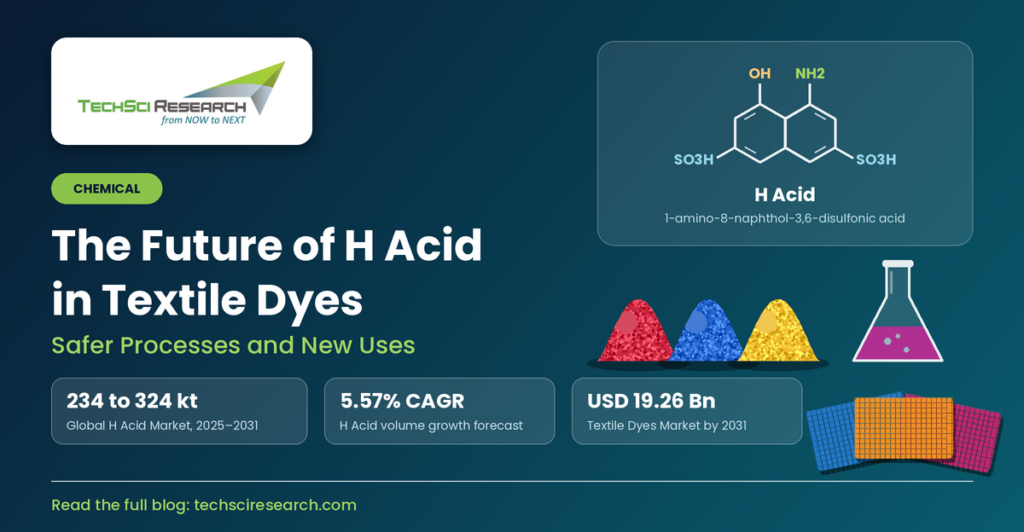
According to TechSci Research report, the Global H Acid Market is projected to grow from 234.01 thousand tonnes in 2025 to 323.95 thousand tonnes by 2031, at a CAGR of 5.57%, driven by textile dye demand.
According to TechSci Research report, the Global Textile Dyes Market is expected to grow from USD 13.79 billion in 2025 to USD 19.26 billion by 2031, at a CAGR of 5.73%, driven by apparel, home textiles, and technical textiles demand.
These forecasts describe connected but different markets. H Acid is an upstream intermediate measured here by volume, while textile dyes are downstream products measured by value. Growth in textile consumption does not translate equally into H Acid demand because different dyes require different chemical building blocks.
For manufacturers and buyers, the opportunity lies in combining dependable dye chemistry with cleaner production and application-specific product quality.
What Is H Acid?
H Acid is commonly identified as 1-amino-8-naphthol-3,6-disulfonic acid. Its structure contains a naphthalene backbone, an amino group, a hydroxyl group, and two sulfonic acid groups.
In selected azo dye synthesis routes, H Acid acts as a coupling component. It reacts with an appropriate diazonium component to help form the finished dye molecule.
This distinction is important: H Acid is a dye intermediate, not generally a ready-to-use textile dye. Its role is to help manufacturers build colourants with the required chemical structure.
People searching for “H Acid full form” are usually looking for its chemical name. H Acid is a conventional product name rather than an acronym requiring expansion.
H Acid Uses in Textile Dye Manufacturing
H Acid contributes to selected dyes across several application classes. However, “azo,” “reactive,” “direct,” and “acid” do not describe four mutually exclusive categories.
Azo refers to a structural feature, while reactive, direct, and acid describe dye application behaviour. A reactive dye, for example, may also contain an azo linkage.
| Dye Category | Role of H Acid | Important Qualification |
| Reactive dyes | Coupling component in selected structures | The complete molecule determines reactivity and performance |
| Direct dyes | Intermediate for selected azo colourants | Fibre affinity depends on the finished dye |
| Acid dyes | Building block in selected formulations | Application suitability depends on the final structure |
| Azo dyes | Component used to construct azo-linked structures | Azo dyes can belong to several application classes |
Colour strength, wash fastness, and fibre compatibility depend on the complete dye structure and application conditions—not on H Acid alone.
This makes consistency important throughout the supply chain. An intermediate that varies between batches can complicate downstream process control.
Why Safer H Acid Production Matters
H Acid manufacturing can generate wastewater containing colour, salts, residual intermediates, and difficult-to-degrade organic compounds. Managing these streams is a central production challenge.
“Safer processes” should therefore mean demonstrated improvements in worker protection, reaction control, resource use, and waste management. It should not suggest that the chemical has become harmless.
Preventing Waste Before Treatment
Cleaner production begins by identifying where raw materials, water, and recoverable intermediates leave the process.
Segregating suitable streams and evaluating recovery opportunities can help reduce avoidable losses. However, recovered material must meet process requirements before being returned to production.
Reuse without composition checks can introduce impurities or increase salt buildup. The objective is controlled recovery—not recycling every stream regardless of quality.
Improving Wastewater Treatment
Treatment approaches may combine separation, adsorption, chemical oxidation, and other methods according to the wastewater’s characteristics.
Advanced oxidation can help break down persistent organic compounds. Adsorption and membrane processes can support separation, but they also create regeneration, fouling, or concentrate-management requirements.
Colour removal is not the same as complete pollutant removal. Clear-looking water may still contain dissolved organic compounds or salts. Treatment performance must therefore be assessed beyond appearance.
Cleaner Processes: Benefits and Limitations
| Improvement Area | Intended Benefit | What Must Be Verified |
| Resource recovery | Reduce material losses | Recovered-stream purity and reuse compatibility |
| Water reuse | Reduce freshwater demand | Salt accumulation and process suitability |
| Adsorption | Separate selected pollutants | Capacity, regeneration, and spent-material management |
| Membrane separation | Separate or concentrate components | Fouling, energy requirements, and concentrate disposal |
| Advanced oxidation | Degrade persistent organic compounds | Residual pollutants and operating cost |
| Integrated treatment | Address multiple wastewater characteristics | Performance on actual plant effluent |
No single technology should be presented as a universal solution. Laboratory performance, a patented design, and reliable full-scale operation are different levels of evidence.
For producers, the strongest approach combines prevention, recovery, treatment, and monitoring around the actual manufacturing process.
New Uses and Emerging Opportunities
The future of H Acid is not necessarily about replacing its established role. It may involve improving existing dye chemistry and qualifying selected higher-specification applications.
Higher-Specification Textile Dyes
A practical opportunity is supplying H Acid that consistently meets a customer’s validated manufacturing requirements.
Relevant checks include assay, moisture, inorganic salts, insoluble matter, and process-specific impurities. A higher advertised purity is useful only when its measurement basis and relevance are clear.
For dye manufacturers, dependable intermediate quality supports more predictable processing. It does not, by itself, guarantee superior finished-dye performance.
Technical Textiles and Specialty Colourants
Technical textiles and specialised colouration create potential downstream opportunities, but their growth should not automatically be treated as new H Acid demand.
The link must be established through the finished dye. If the required colourant uses H Acid chemistry, it may create an opportunity; if it uses a different intermediate, the connection is weaker.
Similarly, selected non-textile applications require separate technical qualification. Textile-grade material should not automatically be considered suitable for a specialised manufacturing route.
H Acid Price Trends and Supplier Selection
Searches for “H Acid price,” “H Acid price trend,” and “H Acid manufacturers in India” often reflect purchasing intent.
A useful supplier comparison must go beyond price per kilogram. Quotations should be evaluated against the supplied form, active content, moisture, impurity limits, delivery terms, and batch consistency.
For example, a lower-priced wet product may not offer a lower cost per unit of usable material. Different forms and assay bases can make apparently similar quotations difficult to compare.
Before sourcing, buyers should:
- Confirm chemical identity and supplied form.
- Specify assay on a clearly defined basis.
- Review moisture and relevant impurity limits.
- Request certificates of analysis and safety documentation.
- Qualify samples in the intended manufacturing process.
- Assess traceability and batch consistency.
- Compare delivered cost and technical support.
- Review environmental documentation rather than relying on an “eco-friendly” label.
For investment and procurement planning, the Global H Acid Market and Global Textile Dyes Market reports can help connect intermediate demand with downstream application opportunities.
Conclusion
The future of H Acid in textile dyes depends on balancing established chemical usefulness with better production and sourcing practices. Its role in selected reactive, direct, and acid dyes remains important, while cleaner manufacturing requires verified waste reduction, controlled recovery, appropriate wastewater treatment, and consistent product quality. New opportunities should be assessed through qualified applications rather than broad claims about textile growth. Manufacturers and buyers who connect chemistry, environmental performance, and commercial requirements will be better positioned to make informed sourcing and investment decisions.
Source:-
1. Download H Acid Market Research Report – Free Sample
2. Download Textile Dyes Market Research Report – Free Sample

Viscose Filament Yarn (VFY) – A Versatile Fibre for Textile Industry

Key Facts About Indian Cleaning Chemicals Market [Market Research]

Nitrobenzene Market is Expected to Grow at a CAGR of 4.01% by 2030
About Author
