
Hydrobromic Acid vs. Hydrochloric Acid: Key Differences and Common Uses
Introduction
Hydrobromic acid vs. hydrochloric acid is a comparison of two strong mineral acids with different manufacturing roles. Hydrobromic acid supplies bromide ions, while hydrochloric acid supplies chloride ions. This distinction influences reaction pathways, product composition, and suitability for pharmaceutical, chemical, metal-processing, and oilfield applications.
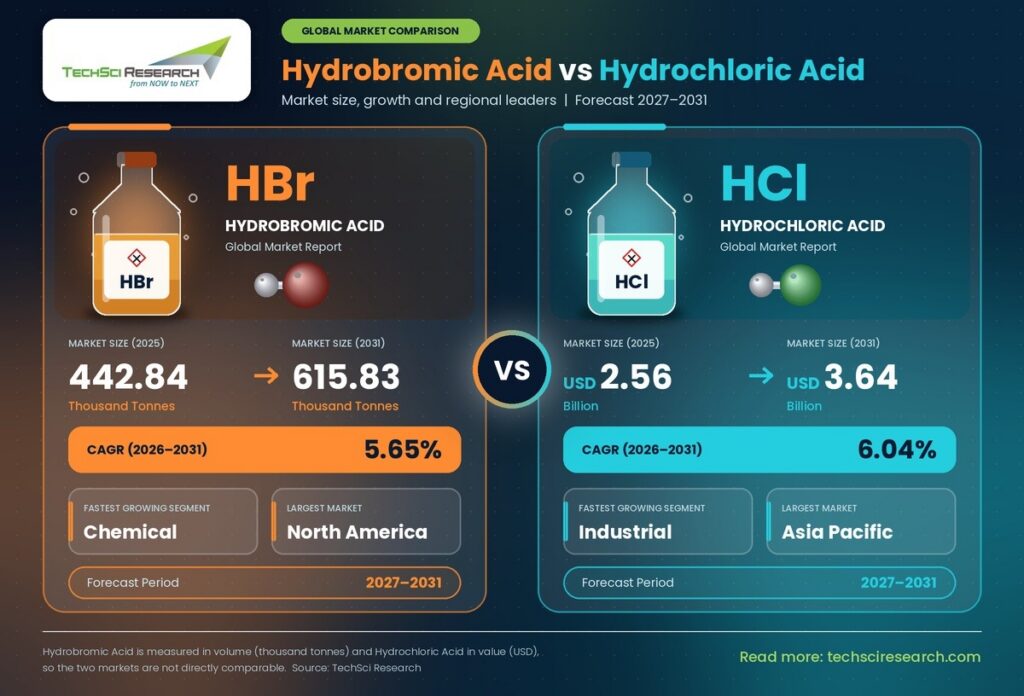
According to TechSci Research report, the Global Hydrobromic Acid Market is expected to grow from 442.84 thousand tonnes in 2025 to 615.83 thousand tonnes by 2031, at a CAGR of 5.65%, driven by chemical, pharmaceutical, and oilfield demand.
According to TechSci Research report, the Global Hydrochloric Acid Market is projected to rise from USD 2.56 billion in 2025 to USD 3.64 billion by 2031, at a CAGR of 6.04%, driven by steel pickling, oil and gas, and chemical manufacturing.
These forecasts use different measurement bases: hydrobromic acid is presented by market volume, while hydrochloric acid is presented by market value. The figures cannot directly establish which market is larger.
For industrial buyers, the practical question is not simply which acid is stronger. It is which acid delivers the required chemistry while meeting concentration, purity, equipment compatibility, and safety requirements.
What Are Hydrobromic Acid and Hydrochloric Acid?
Hydrobromic acid is an aqueous solution of hydrogen bromide, represented as HBr. It provides acidity and bromide ions, making it useful in bromide salt production, pharmaceutical intermediates, and selected specialty chemical processes.
Hydrochloric acid is an aqueous solution of hydrogen chloride, represented as HCl. Also known commercially as muriatic acid, it provides acidity and chloride ions. Common hydrochloric acid uses include steel pickling, pH adjustment, chloride production, and chemical manufacturing.
The distinction between the compound and its solution matters. Hydrogen bromide and hydrogen chloride refer to the compounds themselves; hydrobromic acid and hydrochloric acid generally refer to their aqueous solutions.
HBr vs. HCl: Key Differences at a Glance
| Comparison Factor | Hydrobromic Acid | Hydrochloric Acid |
| Formula | HBr in water | HCl in water |
| Halide ion supplied | Bromide | Chloride |
| Classification | Strong mineral acid | Strong mineral acid |
| Common concentrated commercial grade | Approximately 48% by weight | Approximately 35–37% by weight |
| Main manufacturing role | Bromide chemistry and specialty synthesis | Chloride chemistry, metal processing, and pH control |
| Representative applications | Pharmaceuticals, bromide salts, oilfield chemicals | Steel pickling, water treatment, chemicals, oil and gas |
| Main substitution concern | Introduces bromide into the process | Introduces chloride into the process |
Commercial concentration ranges are not universal specifications. Buyers should verify the actual concentration, impurity limits, and intended product grade.
Which Is Stronger: Hydrobromic Acid or Hydrochloric Acid?
Hydrobromic acid has greater intrinsic acid strength than hydrochloric acid. However, both dissociate extensively in water and behave as strong acids in ordinary dilute aqueous solutions because of water’s levelling effect.
This makes acid strength alone an insufficient purchasing criterion. Concentration, reaction conditions, and the required halide often matter more.
Acid strength and acid concentration describe different properties:
- Acid strength describes the tendency to donate a proton.
- Acid concentration describes how much acid is present in the solution.
A higher-concentration product is not automatically more suitable. It may introduce different dosing, corrosion, handling, and formulation requirements.
Common Uses of Hydrobromic Acid
Bromide Salt Production
One of the principal hydrobromic acid uses is manufacturing inorganic bromides. In these processes, HBr supplies the bromide required in the finished salt rather than functioning only as a pH-adjustment chemical.
Replacing it with hydrochloric acid would introduce chloride instead, potentially changing the product composition.
Pharmaceutical Intermediates and Salt Formation
Hydrobromic acid supports selected pharmaceutical synthesis routes, intermediate production, and hydrobromide salt formation.
These functions should remain distinct. A synthesis reagent helps produce or transform a molecule, while salt formation changes the ionic form of a suitable compound.
Selection depends on the validated manufacturing route and impurity requirements. Technical-grade hydrobromic acid should not automatically be considered suitable for pharmaceutical production.
Oilfield Chemical Manufacturing
Hydrobromic acid is a feedstock for certain bromide salts used in oilfield completion fluids.
Its role is upstream: manufacturers use the acid to produce specified bromide products. HBr itself should not be confused with the finished completion fluid.
Common Uses of Hydrochloric Acid
Steel Pickling and Metal Processing
Hydrochloric acid removes oxide scale from steel before downstream operations such as coating or galvanising. This makes steel pickling an important industrial application.
The treatment requires control because HCl can also attack the underlying metal. Suitable equipment and operating conditions are therefore essential.
pH Control and Water Treatment
Hydrochloric acid supports pH adjustment, neutralisation of alkaline streams, and regeneration of certain ion-exchange resins.
Although acidity may be the immediate requirement, the added chloride remains relevant. It can affect downstream water specifications, equipment compatibility, and discharge requirements.
Chemical and Pharmaceutical Manufacturing
HCl supports chloride production, chemical synthesis, and manufacturing selected pharmaceutical hydrochloride salts.
As with HBr, the appropriate grade depends on the application. Industrial acid specifications do not automatically satisfy pharmaceutical or other specialised requirements.
Oil and Gas Applications
Hydrochloric acid is used in selected well-acidising treatments, particularly where carbonate minerals need to be dissolved.
This application requires engineered treatment design and corrosion control. It differs from hydrobromic acid’s role in bromide salt manufacturing, even though both acids serve the oil and gas industry.
Can Hydrobromic Acid Replace Hydrochloric Acid?
Not automatically. Both acids provide strong acidity, but they introduce different ions into the process.
In bromide production, HCl cannot simply replace HBr without changing the chemistry. Likewise, introducing bromide into a chloride-based process may alter product composition or downstream requirements.
Even for general pH adjustment, substitution requires technical evaluation. A similar final pH does not demonstrate equivalent process chemistry.
| Process Requirement | Relevant Starting Point | Main Decision Factor |
| Bromide salt production | Hydrobromic acid | Required bromide composition |
| Chloride salt production | Hydrochloric acid | Required chloride composition |
| Steel pickling | Hydrochloric acid | Scale removal and corrosion control |
| Pharmaceutical manufacturing | Route-dependent | Validated chemistry and impurity limits |
| Oilfield completion-salt production | Hydrobromic acid | Finished bromide-salt specification |
| General pH adjustment | Application-dependent | Halide tolerance and downstream effects |
The correct selection begins with the process requirement—not with a general assumption that one strong acid can replace another.
Important Checks Before Sourcing Industrial Acids
Before selecting an industrial acid supplier, manufacturers and procurement teams should:
- Specify concentration separately from purity and impurity limits.
- Confirm whether bromide or chloride is acceptable.
- Review certificates of analysis and batch consistency.
- Verify the required technical, laboratory, or pharmaceutical grade.
- Assess compatibility with tanks, piping, seals, and packaging.
- Evaluate ventilation, handling, and exposure controls.
- Include waste treatment and logistics in the cost comparison.
- Qualify substitutions before changing an established process.
Both acids are corrosive and can cause serious injury through contact or inhalation. Handling requires trained personnel, appropriate protective equipment, engineering controls, and product-specific safety procedures.
Neither acid should be mixed casually with cleaners or other chemicals. Hydrochloric acid mixed with hypochlorite bleach can release toxic chlorine gas.
Conclusion
The difference between hydrobromic acid and hydrochloric acid begins with bromide versus chloride, but its consequences extend across manufacturing, sourcing, and safety. Hydrobromic acid supports bromide salt production, pharmaceutical intermediates, and selected oilfield chemical applications, while hydrochloric acid serves established uses in steel pickling, pH control, chloride production, and chemical manufacturing.
For manufacturers and buyers, the right industrial acid is the one that delivers the required chemistry while meeting concentration, purity, equipment compatibility, and final-product specifications—not simply the one described as stronger or offered at a lower price.
Source:-
1. Download Hydrobromic Acid Market Research Report – Free Sample
2. Download Hydrochloric Acid Market Research Report – Free Sample

Understanding Calcium Carbonate: Benefits, Uses, and Sources

Asia Pacific to Dominate Global Super Abrasives Market During Forecast Period

United States Agricultural Surfactants Market to Grow at Steady CAGR During forecast period
About Author
