
Carbon Black in EV Tires: Emerging Trends & Demand
Introduction
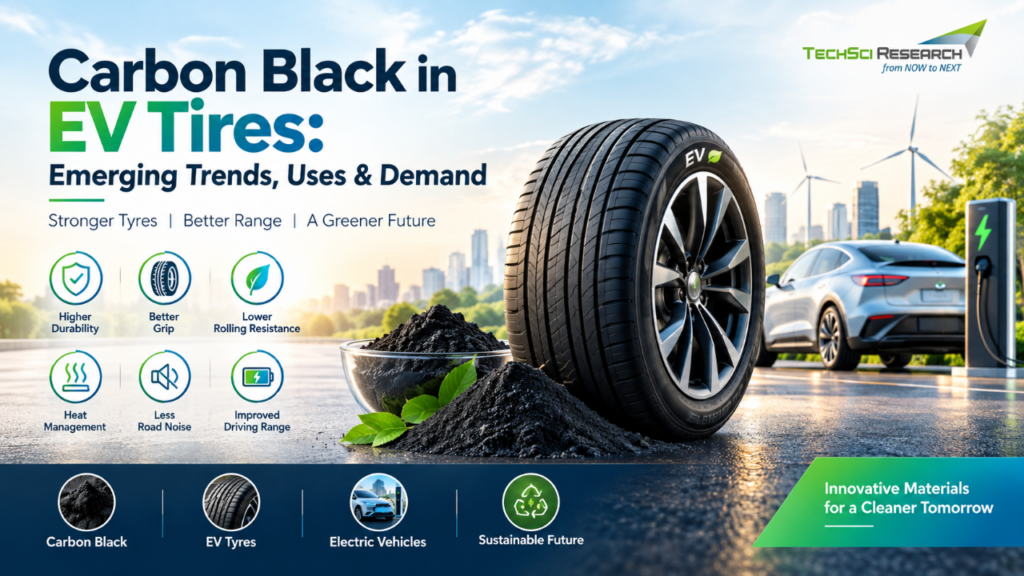
Electric vehicles are heavier than comparable petrol or diesel models because of their battery packs. They also deliver instant, higher torque the moment the accelerator is pressed. Both factors put extra stress on tires, which is why EV-specific tires are formulated differently from conventional ones — and carbon black, the reinforcing filler that gives rubber its strength, is at the center of that shift.
According to the TechSci Research report, the Carbon Black Market size accounted for USD 23.96 Billion in 2025 and is predicted to increase from USD 24.88 Billion in 2026 to approximately USD 30.28 Billion by 2031, expanding at a CAGR of 3.98% from 2026 to 2031.
Industry estimates suggest EV tires require roughly 10% to 15% more carbon black per tire than tires built for conventional vehicles. This is largely to compensate for the added weight and torque load.
Tire and industrial rubber applications continue to account for close to three-quarters of total global carbon black consumption. EV-driven demand is one of the biggest reasons that share is holding steady, even as other materials compete for space in tire formulations.
The story isn’t just about “more carbon black” — it’s about which grades. Standard furnace black still dominates by volume. But the fastest growth is happening in specialty categories: recovered carbon black recycled from scrap tires, and conductive grades built for battery safety rather than tread reinforcement.
Why Carbon Black Matters in EV Tires
Carbon black isn’t just a coloring agent. It’s the reinforcing backbone that determines how a tire wears, grips, and holds up under load.
In EV applications, tire wear can run up to 30% higher than in comparable internal combustion vehicles. This is because of the added weight and the way electric motors deliver torque instantly rather than building it up gradually.
That’s pushed tire makers toward specialized carbon black grades engineered specifically for abrasion resistance and lower rolling resistance, since EV owners are also watching range and efficiency closely.
| EV Tire Requirement | Carbon Black Feature to Prioritize | Best Use Case |
| Higher load-bearing capacity | High-structure reinforcing grades | Heavier battery-electric sedans and SUVs |
| Reduced rolling resistance | Low-hysteresis, energy-efficient grades | Range-focused EVs and city commuting |
| Faster wear from instant torque | High-abrasion-resistance specialty blacks | Performance EVs and frequent stop-start driving |
| Battery and electronics safety | Conductive/acetylene black grades | Battery trays, connectors, charging housings |
| Sustainability compliance | Recovered carbon black (rCB) | OEMs targeting circular-economy and ESG goals |
| Noise and comfort | Fine-particle furnace black blends | Premium EVs prioritizing a quiet ride |
Before finalizing a tire compound or sourcing decision, manufacturers typically validate the carbon black grade against the tire’s target load index, expected duty cycle, and the OEM’s rolling-resistance and durability specifications.
Higher Wear Resistance: The Core Demand Driver
The single biggest reason EV tires consume more carbon black is wear. EVs are heavier and deliver torque instantly rather than progressively, so tread wears down faster than on a similar internal-combustion vehicle — industry reporting puts the gap at up to 30%.
This has pushed tire manufacturers to demand high-performance carbon black grades engineered specifically for abrasion resistance. At the same time, they need to keep rolling resistance low so range isn’t sacrificed for durability.
This dual requirement — tougher tread without added drag — is one of the more difficult formulation challenges the industry is currently working through.
Recovered Carbon Black (rCB): The Circular Economy Push
Sustainable, recycled carbon black recovered from end-of-life tires through pyrolysis is one of the fastest-growing segments in the industry.
Analysts tracking this space project the broader recovered carbon black market growing at a CAGR in the mid-to-high teens through 2030. Some regional forecasts for EV-specific conductive rCB put growth even higher — in the range of 13% to 22% annually through the mid-2030s, depending on the region and grade.
Some studies estimate that several million tons of usable carbon black could theoretically be recovered each year from scrap tires. That could be enough to meet a substantial share of global demand if collection and processing infrastructure scales up.
This trend is being driven by two forces at once: tire makers chasing circular-economy and ESG targets, and regulators in markets like the EU and parts of the US pushing recycled-content requirements for new tires. Producers including Cabot Corporation, Birla Carbon, and Orion Engineered Carbons have all been investing in purification technology to bring recovered carbon black up to the purity and consistency levels that automotive-grade applications demand.
Specialty Conductive Grades: Built for the Battery, Not Just the Tread
Beyond the tread itself, EVs have created a second, smaller but fast-growing demand stream: conductive carbon black for managing electrostatic discharge and supporting lithium-ion battery components such as trays, connectors, and charging housings.
Acetylene black and other high-purity, low-ash conductive grades are seeing outsized growth. Battery manufacturers require very specific particle-size distributions and conductivity levels — specifications that only a limited number of producers can currently meet.
This segment is notable because its growth is tied to EV production and battery manufacturing volumes rather than traditional tire replacement cycles. That means it can grow independently of the broader automotive tire market. Orion Engineered Carbons, for instance, has been expanding conductive-grade capacity specifically to serve this demand, while diversifying its revenue away from cyclical tire volumes.
Market Outlook and Leading Producers
Furnace black remains the dominant revenue driver across the overall carbon black market. Tire and industrial rubber applications still account for roughly 70–75% of global consumption by volume.
Asia-Pacific leads global demand, commanding well over 60% of revenue share. China’s carbon black industry is expected to grow faster than the global average through the early 2030s as domestic tire manufacturing capacity expands.
On the supply side, the market remains moderately concentrated. Tokai Carbon, Cabot Corporation, Orion Engineered Carbons, and PCBL (Phillips Carbon Black) rank among the largest global producers by market share, alongside Birla Carbon, Continental Carbon, Mitsubishi Chemical, and several China-based manufacturers.
Most of these players are investing in three directions at once: expanding standard furnace-black capacity to meet base tire demand, scaling recovered carbon black output to meet circularity mandates, and developing conductive and specialty grades for EV batteries and plastics. Some producers are also piloting lower-carbon production methods, including plasma-based methane pyrolysis, which produces carbon black alongside hydrogen with a much smaller carbon footprint than traditional furnace processes.
India’s carbon black market is following the same pattern on a smaller scale. Growth is supported by expanding domestic tire manufacturing, rising vehicle production, and growing plastics consumption, with mid-single-digit to high-single-digit percentage annual growth expected through the early 2030s.
Carbon Black Grades: Choosing the Right Type for the Application
Not every carbon black grade suits every part of an EV tire or vehicle system. Choosing the right type depends on where it’s being used — the tread, the sidewall, or a battery component — rather than picking a grade based on cost alone.
| Grade Type | Best For | Key Benefits | Consider Before Buying |
| Standard furnace black | Tire tread and sidewall reinforcement | Cost-effective, proven durability and reinforcement | Limited conductivity; not suited for battery components |
| High-abrasion specialty black | EV tread compounds under high torque | Improved wear resistance, better tread life | Typically priced higher than standard furnace grades |
| Recovered carbon black (rCB) | Sustainability-driven tire manufacturing | Lower carbon footprint, supports circular-economy goals | Feedstock variability can affect consistency |
| Acetylene/conductive black | Battery trays, connectors, charging housings | High purity, precise conductivity control | Stricter qualification requirements and higher qualification cost |
| Hybrid silica-carbon black blends | Premium low-rolling-resistance tires | Lower rolling resistance, improved efficiency labeling | Requires reformulated compounding and process changes |
For most standard EV tire manufacturing, high-abrasion specialty carbon black remains the practical default. Conductive and hybrid grades are better suited to premium EVs, performance-focused models, or applications where battery safety and efficiency labeling are the priority.
Important Checks Before Sourcing Carbon Black for EV Tires
- Match the carbon black grade to the tire’s target load index and expected duty cycle.
- Verify particle size, structure, and purity levels against the OEM’s technical specification.
- Confirm whether recycled content (rCB) meets applicable regional regulatory requirements.
- Check conductivity specifications separately for tread-grade versus battery-component applications.
- Evaluate the supplier’s production method (furnace, acetylene, or pyrolysis-based) against sustainability targets.
- Request consistency data across batches, especially for recovered carbon black feedstock.
- Assess long-term supply agreements given the industry’s current capacity constraints in specialty grades.
- Track evolving efficiency and emissions-labeling requirements that may affect formulation choices.
Conclusion
Carbon black in EV tires is no longer a single-product story. It’s a market splitting into distinct, fast-growing lanes.
Standard furnace black continues to anchor overall volume and revenue. But recovered carbon black and conductive specialty grades are growing several times faster, as circular-economy mandates and battery safety requirements reshape demand.
With the global carbon black market on track for steady growth through the early 2030s, and EV-specific segments growing considerably faster, manufacturers and buyers who get ahead of grade-level sourcing decisions — rather than treating carbon black as a single commodity — will be better positioned as the EV tire category continues to expand.

Automotive ventilated seats Market To Register Impressive CAGR During the Forecast Period

The Splendid Eventual Fate of Connected Car Devices Market- in Fast Lane

Fast Charging Segment to Push Global Electric Vehicle Connector Market till 2024
About Author
