
Blockchain Technology: How It Works, Applications, Benefits & Future Trends
Introduction
Blockchain technology has evolved from being primarily associated with cryptocurrencies to becoming an important digital infrastructure for businesses, governments, financial institutions, supply chains, healthcare organizations, and technology companies. Its ability to record transactions in a decentralized, transparent, and tamper-resistant manner makes it useful wherever data integrity and trust are important.
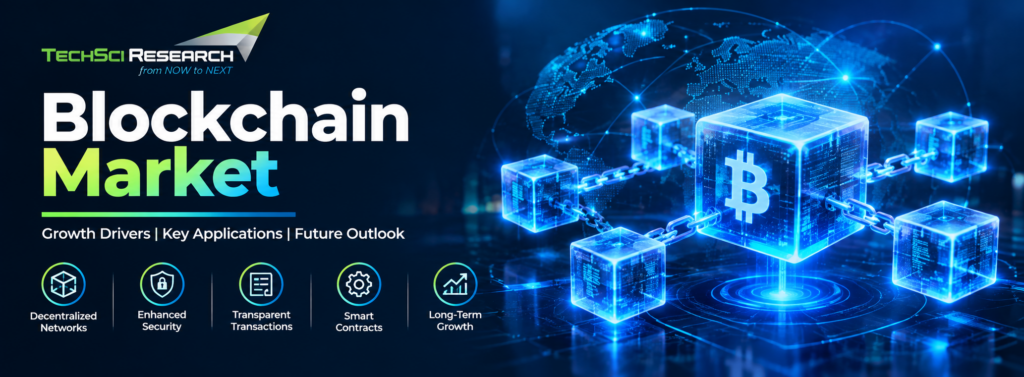
According to TechSci Research, The Global Blockchain Market is projected to grow from USD 23.62 Billion in 2025 to USD 420.03 Billion by 2031 at a 61.56% CAGR.Unlike traditional databases that are generally controlled by a central organization, blockchain distributes transaction records across a network of computers. Once information is validated and added to the blockchain, changing it becomes extremely difficult without network agreement.
Today, blockchain is being explored for applications ranging from digital payments and supply chain tracking to smart contracts, identity management, tokenization, healthcare records, and decentralized applications.
What Is Blockchain Technology?
Blockchain is a distributed digital ledger that records information in a series of connected blocks. Each block contains transaction data along with information that links it to the previous block.
A typical blockchain network includes:
- Blocks – Store transaction or data records.
- Nodes – Computers that participate in maintaining the network.
- Consensus mechanisms – Help participants agree on valid transactions.
- Cryptography – Protects information and transaction integrity.
- Smart contracts – Enable predefined rules and processes to execute automatically.
Because copies of the ledger can exist across multiple participating computers, blockchain can reduce dependence on a single central authority.
Blockchain vs Traditional Databases
Blockchain does not necessarily replace conventional databases. Instead, it offers a different approach to storing and sharing information.
| Feature | Blockchain | Traditional Database |
|---|---|---|
| Control | Distributed or shared | Usually centrally managed |
| Data modification | Highly controlled and traceable | Can generally be modified by authorized users |
| Transparency | Can provide shared visibility | Access depends on permissions |
| Security approach | Cryptography + consensus + distributed architecture | Access controls, encryption, and centralized security |
| Best suited for | Multi-party records and transactions | Centralized applications and high-speed data management |
Organizations typically choose blockchain when multiple parties need to share trusted records without relying entirely on one central database administrator.
Major Types of Blockchain
Blockchain networks can be categorized according to who can participate and how the network is controlled.
Public Blockchain
Public blockchains are generally open networks where participants can join and interact according to the network’s rules. They are commonly associated with decentralized digital assets and applications.
Private Blockchain
Private blockchains are controlled by a specific organization. Access can be restricted to approved participants, making them suitable for certain enterprise applications.
Consortium Blockchain
A consortium blockchain is managed by multiple organizations rather than a single entity. It can be useful when businesses need to collaborate and share records while maintaining controlled access.
Hybrid Blockchain
Hybrid blockchain combines elements of public and private blockchain structures, allowing organizations to control sensitive information while selectively sharing certain records.
Key Applications of Blockchain Technology
Blockchain has applications well beyond cryptocurrency.
Financial Services
Banks and financial institutions are exploring blockchain for cross-border payments, transaction settlement, digital assets, trade finance, and automated financial agreements.
Blockchain can potentially reduce the number of intermediaries involved in certain transactions while improving traceability and settlement processes.
Supply Chain Management
Supply chains involve multiple participants, including manufacturers, suppliers, logistics providers, distributors, retailers, and customers. Blockchain can create a shared record of product movement across these participants.
This can help organizations improve:
- Product traceability
- Shipment visibility
- Record accuracy
- Supplier verification
- Counterfeit detection
- Compliance monitoring
Healthcare
Healthcare organizations can explore blockchain for secure data sharing, medical credential verification, pharmaceutical traceability, and management of healthcare-related records.
However, sensitive patient information still requires appropriate privacy controls and should not automatically be placed directly on a public blockchain.
Digital Identity
Blockchain-based identity solutions can provide individuals with greater control over certain digital credentials. Organizations can use verifiable credentials to confirm identity, qualifications, certifications, or access rights.
Real Estate
Blockchain can support property-related record management, digital contracts, ownership verification, and tokenization of certain assets. Smart contracts may also automate selected steps in real estate transactions.
Blockchain Use Cases Across Industries
| Industry | Blockchain Use Case | Potential Benefit |
|---|---|---|
| Banking | Payments and settlement | Faster and more traceable transactions |
| Supply Chain | Product tracking | Improved visibility and traceability |
| Healthcare | Credential and record management | Better data integrity and controlled sharing |
| Real Estate | Property records and tokenization | Greater transparency |
| Retail | Product authenticity | Counterfeit reduction and provenance |
| Government | Digital records | Secure and auditable record management |
| Insurance | Claims processing | Automation and improved verification |
| Manufacturing | Component tracking | Better supply chain visibility |
Emerging Trends in Blockchain
Blockchain and Artificial Intelligence
AI and blockchain are increasingly being explored together. Blockchain can provide data provenance and transaction records, while AI can analyze data and automate decision-making.
Real-World Asset Tokenization
Tokenization involves representing ownership or rights related to real-world assets digitally. Financial assets, real estate, commodities, and other assets are being explored for tokenization.
Decentralized Finance
Decentralized finance, or DeFi, uses blockchain-based applications to provide financial services through smart contracts and decentralized protocols.
Central Bank Digital Currencies
Central banks worldwide continue to explore digital forms of national currencies. While CBDCs are not identical to cryptocurrencies, blockchain and distributed-ledger technologies can play a role in some digital currency architectures.
Enterprise Blockchain
Businesses are increasingly focusing on practical blockchain applications rather than adopting the technology simply for experimentation. Supply chain visibility, identity, payments, compliance, and asset tracking remain important areas of interest.
Challenges of Blockchain Technology
Despite its potential, blockchain adoption comes with challenges.
- Scalability can be difficult for certain blockchain architectures.
- Energy consumption varies significantly depending on the consensus mechanism.
- Regulatory requirements differ across countries and applications.
- Integrating blockchain with existing IT systems can be complex.
- Smart contract errors can create significant operational risks.
- Privacy can be challenging when information is permanently recorded.
- Blockchain governance becomes important when multiple organizations share a network.
Therefore, businesses need to evaluate whether blockchain genuinely solves a specific problem before implementing it.
Conclusion
Blockchain technology is moving beyond its original association with cryptocurrencies and becoming a broader technology for trusted digital transactions, shared records, automation, and asset management. Its decentralized architecture, cryptographic security, traceability, and smart-contract capabilities make it attractive for industries such as finance, supply chain, healthcare, manufacturing, government, insurance, and real estate.
However, blockchain is not a universal replacement for traditional databases. Its strongest value comes in situations where multiple participants need to coordinate, verify, and share records without depending entirely on a single centralized authority.
As enterprises explore tokenization, digital identity, smart contracts, decentralized applications, and blockchain-AI integration, the technology is likely to remain an important part of the evolving digital economy.

Premium Version Segment to Register Significant Growth in US Dating Apps Market until 2024

Saudi Arabia Telecom ICT Infrastructure Market to Be Valued USD 1879.35 Million by 2025
Europe Content Delivery Network Market to Cross $ 16 Billion by 2025
About Author
