
Understanding Calcium Carbonate: Benefits, Uses, and Sources
Introduction
Calcium carbonate is one of those materials people use every day without noticing it. It is present in chalk, toothpaste, antacid tablets, paper, wall paint, plastic packaging, adhesives, sealants, cement, and even certain food and pharmaceutical products. Its wide use comes from one simple advantage: it is abundant, versatile, and cost-effective.
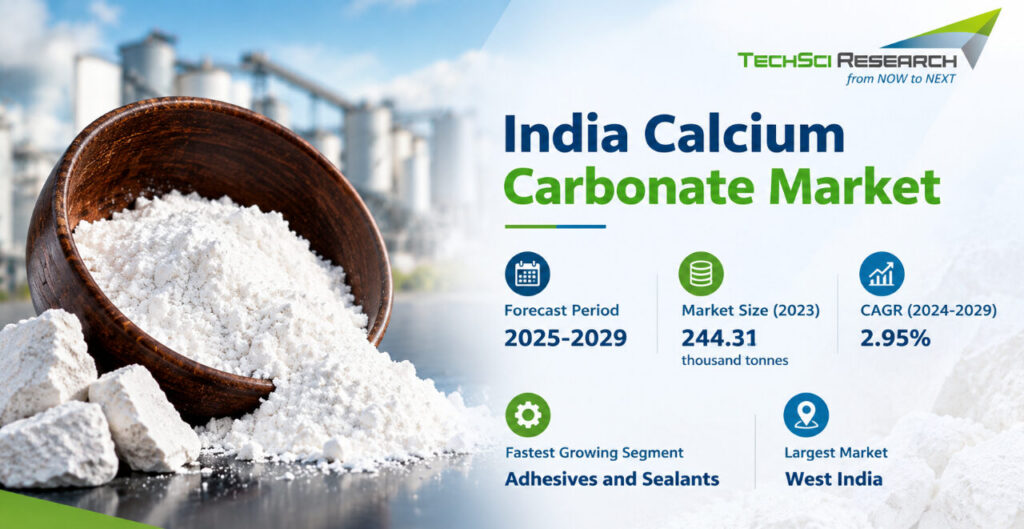
According to TechSci Research, the India Calcium Carbonate Market reached 244.31 Thousand Tonnes in 2023 and is expected to grow at a CAGR of 2.95% during 2024–2029. Market growth is supported by rising demand from paper, plastics, construction, paints and coatings, adhesives, sealants, and other industrial applications.
Chemically known as CaCO_3, calcium carbonate occurs naturally in limestone, chalk, marble, calcite, and shells. But industrial buyers do not purchase it as a single, standard material. They select different grades based on particle size, brightness, purity, surface treatment, and the performance required in the final product.
The story is not just about using calcium carbonate as a low-cost filler. It is increasingly about choosing the right grade for specific needs—whether the priority is paper brightness, plastic stiffness, paint viscosity, adhesive rheology, or high-purity pharmaceutical and food formulations.
What Is Calcium Carbonate?
Calcium carbonate is a naturally occurring inorganic compound made of calcium, carbon, and oxygen. Its chemical formula is CaCO_3.
It is one of the most common minerals found in the Earth’s crust and occurs in several natural forms:
- Limestone
- Chalk
- Marble
- Calcite
- Aragonite
- Seashells and marine deposits
For industrial use, calcium carbonate is mined, processed, ground, classified, and sometimes chemically modified to meet end-user specifications. It is valued for its white color, fine particle size, opacity, availability, and ability to improve product properties at a relatively low cost.
Calcium carbonate is widely used as a filler in plastic, paper, paint, adhesive, sealant, rubber, and coating applications. It can also be used in pharmaceutical formulations, food products, toothpaste, supplements, and antacids.
Where Does Calcium Carbonate Come From?
Most commercial calcium carbonate comes from natural limestone and marble deposits. These materials are extracted through mining and then processed into powders or engineered particles for industrial use.
Natural Calcium Carbonate Sources
Limestone is the biggest commercial source of calcium carbonate. It is crushed and processed for cement, construction aggregates, industrial fillers, agriculture, paper, plastics, paints, and coatings.
Chalk is a softer and finer form of calcium carbonate. It is commonly associated with writing chalk, but it is also used in selected industrial applications.
Marble is a crystalline calcium carbonate rock valued in construction and decorative applications. It can also be processed into high-whiteness calcium carbonate grades for paper, paints, and plastics.
Shells and marine deposits are also naturally rich in calcium carbonate. They can be processed into specialized products, although limestone remains the most common commercial raw material source.
GCC vs PCC: The Two Major Types
Most industrial calcium carbonate falls into two categories: Ground Calcium Carbonate and Precipitated Calcium Carbonate.
| Type | How It Is Made | Best Used In | Main Advantage |
| Ground Calcium Carbonate (GCC) | Natural limestone, marble, or chalk is crushed and ground | Construction, paper, plastics, paints, rubber | Cost-effective and widely available |
| Precipitated Calcium Carbonate (PCC) | Produced through a controlled chemical process | Premium paper, pharmaceuticals, food, specialty plastics | Better particle-size and shape control |
GCC is generally selected for high-volume applications where cost efficiency is important. PCC is preferred when manufacturers need more controlled particle properties, higher purity, better dispersion, or specific performance in the final formulation.
The difference matters because two calcium carbonate products may have the same chemical formula but perform very differently in a plastic compound, paper coating, paint formulation, adhesive, or tablet.
Why Calcium Carbonate Matters Across Industries
Calcium carbonate is not simply added to reduce cost. In many applications, it contributes directly to product appearance, processing efficiency, strength, consistency, and performance.
| Industry Requirement | Calcium Carbonate Feature | Typical Application |
| Higher brightness and opacity | Fine, high-whiteness grades | Paper coatings and printing paper |
| Lower formulation cost | Cost-effective mineral filler | Plastics, rubber, paints, sealants |
| Better stiffness | Controlled particle-size grades | PVC pipes, profiles, packaging films |
| Smooth surface finish | Fine particle distribution | Decorative paints and coatings |
| Viscosity and rheology control | Functional filler properties | Adhesives, caulks, sealants |
| High purity | Food- and pharmaceutical-grade calcium carbonate | Tablets, supplements, food products |
| Construction strength and bulk | Limestone-based grades | Cement, mortar, wall putty, tiles |
Before selecting a grade, manufacturers usually evaluate particle size, brightness, moisture content, purity, surface treatment, dispersion, and compatibility with their specific product formulation.
Calcium Carbonate in Everyday Products
Calcium carbonate appears in more products than most consumers realize.
Toothpaste and Personal Care
In toothpaste, calcium carbonate can act as a mild abrasive and help improve texture. It may also be used in selected cosmetic and personal-care formulations to support opacity, absorbency, and product consistency.
Antacids and Supplements
Calcium carbonate is commonly used in antacid products to neutralize stomach acid and provide temporary relief from occasional acidity or heartburn. It is also used in dietary calcium supplements.
However, supplements and antacids should be taken according to label directions or healthcare advice. People with kidney conditions, a history of kidney stones, high blood-calcium levels, or ongoing medication use should consult a qualified healthcare professional before taking calcium supplements regularly.
Food Applications
In permitted food applications, calcium carbonate may be used as a nutrient source, formulation aid, anticaking agent, color-related ingredient, or pH-control component. It is also used in some calcium-fortified food products.
Chalk and Household Products
Chalk is one of the most recognizable forms of calcium carbonate. The mineral also appears in household cleaners, polishing products, certain detergents, and other everyday products where mild abrasive or bulk properties are needed.
Paper Industry: A Major Demand Center
Paper is one of the largest end-use sectors for calcium carbonate. Both GCC and PCC are used as fillers and coating pigments in writing paper, printing paper, packaging paper, tissue, and specialty paper grades.
Calcium carbonate helps paper manufacturers improve:
- Brightness and whiteness
- Opacity and printability
- Smoothness and surface finish
- Ink absorption
- Cost efficiency by reducing pulp usage
Paper manufacturers often choose calcium carbonate grades based on particle-size distribution and light-scattering performance. Fine PCC grades may be used in premium coated paper, while GCC is widely used in cost-sensitive paper and packaging applications.
Plastics, Paints, and Coatings
Calcium carbonate is a major filler in PVC, polyethylene, polypropylene, and other polymer materials. It can help manufacturers improve stiffness, dimensional stability, surface finish, and cost efficiency.
In PVC products such as pipes, profiles, cable compounds, flooring, sheets, and films, calcium carbonate is widely used because it can improve bulk and help manage formulation costs. Surface-treated grades are often preferred when better polymer compatibility and dispersion are required.
In paints and coatings, calcium carbonate works as an extender. It supports viscosity control, texture, coverage, and matte finish development. Fine grades are frequently used in wall paints, primers, putty, decorative coatings, and industrial coating formulations.
Calcium carbonate is widely recognized as a filler material across plastic, paper, paint, sealant, and adhesive industries because particle properties can be tailored to the performance requirement.
Construction, Adhesives, and Sealants
Construction remains a key market for calcium carbonate. Limestone is used in cement manufacturing, road aggregates, concrete products, mortar, tiles, wall putty, and decorative building materials.
In adhesive and sealant formulations, calcium carbonate works as a functional filler. It can help control viscosity, rheology, consistency, and bulk while improving the economics of the final product.
Common applications include:
- Wall putty and cementitious products
- Tile adhesives
- Acrylic sealants
- Silicone sealants
- Construction adhesives
- Caulking compounds
- Mortar and plaster
- Concrete blocks and building materials
The growing construction sector, infrastructure investments, packaging consumption, and demand for paints and plastics continue to support calcium carbonate consumption in India.
Choosing the Right Calcium Carbonate Grade
Not every calcium carbonate grade is suitable for every application. Choosing a product based only on price can create problems with dispersion, finish, viscosity, mechanical strength, or manufacturing efficiency.
| Grade Type | Best For | Key Benefits | Consider Before Buying |
| Standard GCC | Construction, rubber, general plastics | Low cost and wide availability | Particle control may be limited |
| Fine GCC | Paints, paper, PVC, coatings | Better finish, brightness, and dispersion | Requires consistent supplier quality |
| PCC | Premium paper, food, pharma, specialty polymers | Controlled particle size and high purity | Higher cost than standard GCC |
| Surface-treated calcium carbonate | Plastics, sealants, adhesives | Better polymer compatibility and moisture resistance | Treatment must match resin system |
| Food/pharma-grade calcium carbonate | Supplements, tablets, food products | High purity and controlled quality | Regulatory compliance is essential |
For basic construction and bulk applications, standard GCC is often the practical choice. For high-performance paper, coatings, plastic compounds, pharmaceutical products, or food applications, fine GCC, PCC, or specially treated grades may offer better results.
Important Checks Before Sourcing
Manufacturers and buyers should consider these points before finalizing a calcium carbonate supplier or grade:
- Match the grade with the final application—paper, plastic, paint, adhesive, sealant, construction, food, or pharmaceuticals
- Check particle size and particle-size distribution
- Verify whiteness, brightness, and opacity requirements
- Confirm purity and moisture-content specifications
- Evaluate surface treatment for plastic and polymer applications
- Test dispersion in the actual production formulation
- Check food-grade or pharmaceutical-grade compliance where required
- Compare GCC and PCC based on performance needs, not only price
- Review supplier batch consistency and long-term supply capability
- Consider transport costs, packaging format, and local availability
Conclusion
Calcium carbonate is one of the most versatile mineral materials used in modern manufacturing. It supports everyday products such as toothpaste, antacids, paper, paints, plastics, adhesives, sealants, construction materials, food products, and pharmaceutical tablets.
GCC continues to dominate large-volume applications because it is cost-effective and readily available. PCC and surface-treated grades are gaining importance in premium and performance-focused segments where particle control, purity, brightness, and dispersion matter more.
For manufacturers, the key decision is not whether to use calcium carbonate, but which grade delivers the right balance of cost, performance, processing efficiency, and product quality. As demand rises across paper, construction, plastics, coatings, and consumer goods, application-specific calcium carbonate sourcing will become increasingly important.

Top Investment Pockets in US Polycarbonate Industry

The Art and Science of Mixed Waste Plastic Recycling: A Sustainable Odyssey

Asia-Pacific to Dominate Automotive Refinish Coatings Market through 2024
About Author
